
In the evolving landscape of business automation, the concept of agentic workflows is quickly gaining traction. Unlike traditional automation, which follows rigid, predefined rules, agentic workflows introduce a layer of intelligence—systems that can make decisions, adapt to changing inputs, and orchestrate tasks dynamically. For businesses looking to scale operations, reduce manual effort, and enhance customer experiences, this shift represents a meaningful leap forward.
What Are Agentic Workflows?
At a technical level, agentic workflows combine automation with decision-making logic, often powered by AI models or rule-based agents. Instead of simply executing a linear sequence (e.g., “if X happens, do Y”), these workflows can:
- Interpret context from multiple data sources
- Decide between multiple possible actions
- Trigger downstream processes conditionally
- Learn or adapt over time (when integrated with AI systems)
Think of them as digital operators rather than static pipelines. They don’t just do—they decide what to do next.
Why Businesses Are Moving Toward Agentic Systems
Modern businesses operate in environments where variability is the norm: customer queries differ, operational exceptions occur, and data flows are rarely clean. Agentic workflows address these realities by introducing flexibility and intelligence into operations.
Key benefits include:
- Operational efficiency: Reduced reliance on manual intervention
- Scalability: Systems handle increasing complexity without proportional headcount
- Improved customer journeys: Faster, more personalized responses
- Resilience: Ability to handle exceptions without breaking workflows
Where n8n Fits In
n8n is a workflow automation platform that provides a flexible, node-based environment for building both simple and advanced automations. While it started as a traditional automation tool, its extensibility makes it highly suitable for building agentic workflows.
Key characteristics that make n8n ideal:
- Visual workflow builder: Rapid prototyping and iteration
- Custom logic support: JavaScript functions, conditional routing
- API-first architecture: Seamless integration with CRMs, databases, and AI services
- Self-hosting capability: Greater control over data and infrastructure
This combination allows businesses to move beyond static automation into dynamic orchestration.
Designing an Agentic Workflow in n8n
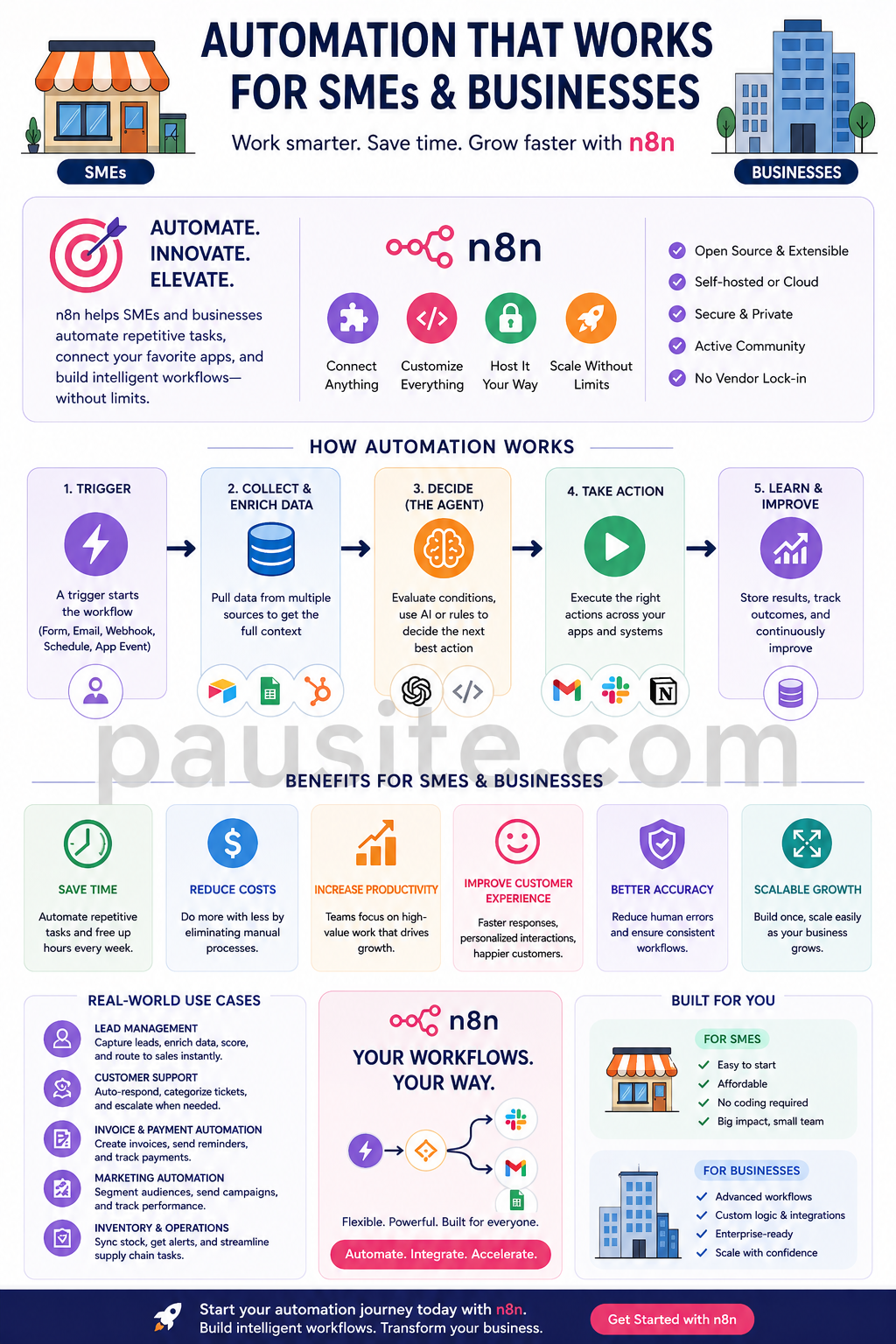
To understand how agentic workflows come together, consider a typical business use case: automated customer engagement.
Step 1: Input Collection
Trigger the workflow via incoming data—this could be a form submission, chatbot message, or email.
Step 2: Context Enrichment
Pull additional data from systems such as CRM, past interactions, or analytics platforms.
Step 3: Decision Layer (The “Agent”)
This is where agentic behavior emerges. Using conditional nodes or AI integrations, the system evaluates:
- Customer intent
- Urgency level
- Historical behavior
Based on this, it determines the next best action.
Step 4: Action Execution
Possible actions may include:
- Sending a personalized response
- Assigning a lead to sales
- Triggering a follow-up workflow
- Escalating to a human operator
Step 5: Feedback Loop
Store outcomes to improve future decisions—this could involve logging data or integrating with machine learning systems.
Example: AI-Driven Lead Qualification
An agentic workflow built in n8n could automatically qualify leads:
- Capture inquiry from a website
- Enrich with company and behavioral data
- Use an AI model to score the lead
- Route high-quality leads to sales instantly
- Send nurturing sequences to lower-priority leads
This replaces hours of manual triage with a system that operates continuously and consistently.
Best Practices for Implementation
When deploying agentic workflows, precision in design matters:
- Start with high-impact use cases: Customer support, lead management, and operations are strong entry points
- Define clear decision criteria: Avoid vague logic—explicit conditions improve reliability
- Monitor and iterate: Agentic systems require tuning based on real-world performance
- Balance automation with control: Ensure critical decisions can still involve human oversight when needed
Challenges to Consider
While powerful, agentic workflows are not without complexity:
- Debugging becomes harder due to dynamic decision paths
- Data quality is critical—poor inputs lead to poor decisions
- Over-automation risk—not every process should be fully autonomous
A disciplined approach to design and governance mitigates these risks.
The Future of Business Automation
Agentic workflows represent a shift from automation as a tool to automation as a collaborator. Platforms like n8n enable businesses to build systems that are not just efficient, but adaptive and intelligent.
For organizations aiming to stay competitive, the question is no longer whether to automate—but how intelligently that automation can operate.
The businesses that succeed will be those that design workflows capable of thinking, not just executing.
START DESIGNING YOUR AGENTIC WORKFLOW WITH PAU AI
Comments ()